

By Sara Somasca | BASE YOGA
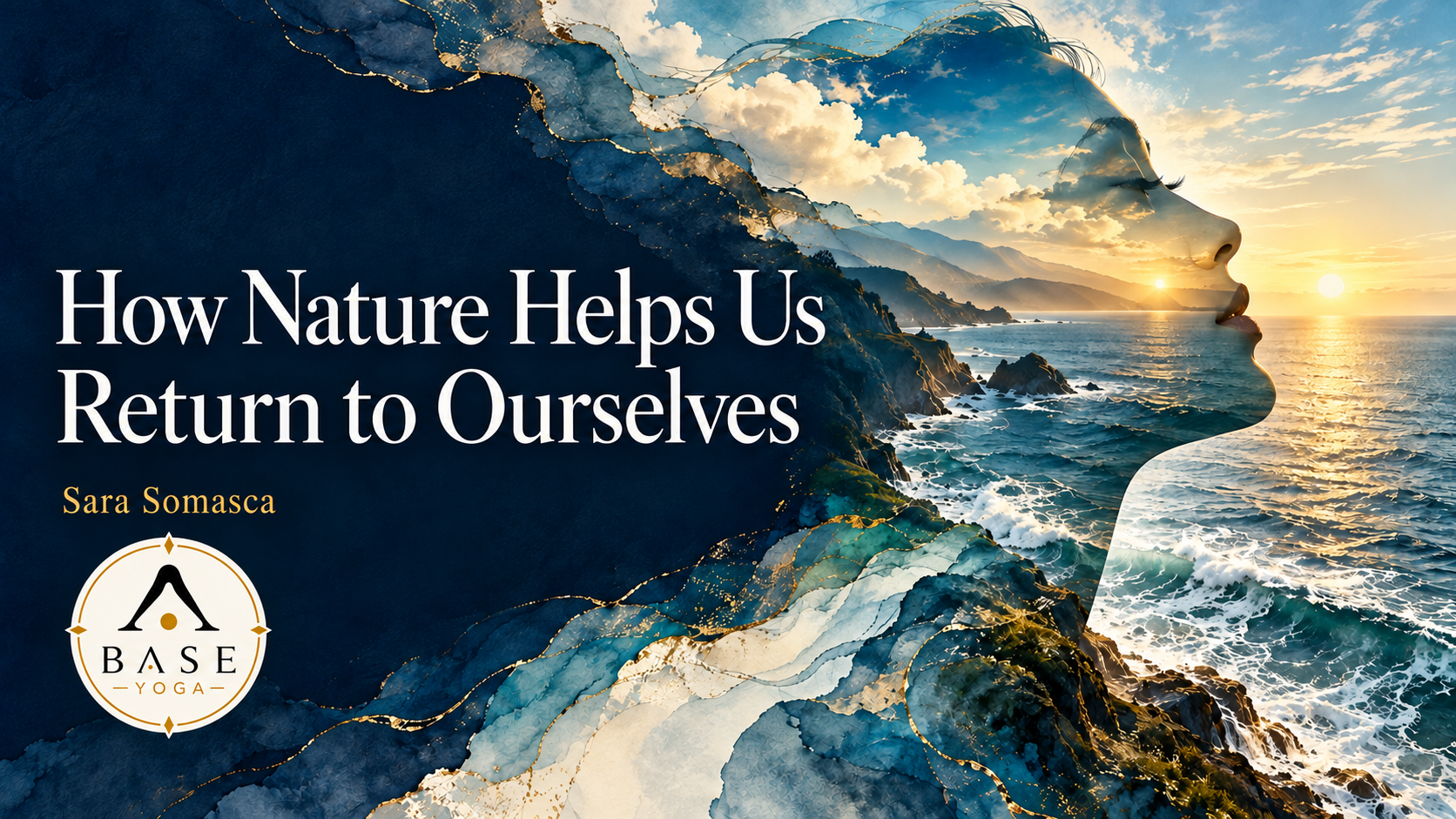
There are moments by the ocean when the pressure to become someone seems to soften. The water keeps moving. The sky opens above us. For a little while, there is nothing to acquire and no one to impress. We can simply be there.
That experience raises a question worth carrying back into everyday life: how much of what we chase helps us live well, and how much of it is an attempt to prove that we are enough?
The places around us matter. Our days unfold within environments that invite certain ways of paying attention. A crowded schedule, constant notifications, and reminders of what others have can keep us focused on what is missing. A view of the horizon can offer room to notice something else.
Research gives some support to this experience. In a 2015 study, participants who took a 90-minute walk in a natural setting reported reduced rumination, the repetitive thinking that keeps us circling our distress. Those who walked in an urban setting did not show the same reduction. This was a specific study, rather than a promise about every outdoor experience, but it suggests that our surroundings can influence how we relate to our thoughts.
A meta-analysis by Alison Pritchard and colleagues also found that people who felt more connected to nature tended to report greater psychological well-being, particularly personal growth. The association does not establish cause and effect. Still, it invites us to take our relationship with the natural world seriously.
Beyond what research can measure, observing nature offers possibilities for reflection. The ocean changes without losing its movement. Trees grow in response to the conditions around them. A landscape holds many rhythms at once. We may find in these observations a useful image of resilience: responding to change, allowing time, and recognizing the support we need.
For me, this is part of returning to our own nature. It means becoming familiar again with our needs, our values, and the pace at which we can live with greater honesty. It means noticing the difference between what nourishes us and what we have learned to want because it signals success.
We can spend years trying to fill a sense of inadequacy with things. Another purchase, a more impressive title, or a different lifestyle may seem to hold the promise of finally feeling complete. When that feeling fades, the search begins again.
Beside the ocean, another possibility can become easier to imagine. We do not need to own the view to receive something from it. The warmth of the sun and the movement of water can be meaningful without becoming possessions. Sometimes, a moment of contentment asks us to pay attention to what is already here.
Of course, having enough to live safely matters. Financial strain, insecure housing, and unmet needs are real sources of suffering. A reflection on simplicity should never turn hardship into a spiritual ideal. There is a meaningful difference between needing resources to live and needing possessions to establish our worth.
Buddhist teachings on clinging offer a related perspective. In his teaching on conventions and release, Ajahn Chah reflects on how we use names, roles, money, and possessions, and how tightly identifying with them can become a source of suffering. These things have practical purposes; the invitation is to recognize the grip they can have on us.
I understand that invitation as learning to hold life more lightly. We can love people deeply, care about our work, and enjoy beautiful things while allowing them to change. Letting go can mean releasing the demand that a relationship, an achievement, or an object must make us permanently secure.
From that perspective, contentment can coexist with ambition. We can work toward a meaningful future while questioning the belief that our present life has no value until we reach it. Our purpose may become clearer when we have room to ask what we care about, beyond what earns approval.
Nature can also change our sense of scale. When worries fill our attention, our immediate circumstances can start to feel like the whole world. Looking across open water may remind us that life continues beyond the boundaries of our current difficulty. Our problems still deserve care, and there is also a wider world to which we belong.
For those of us in helping professions, this matters. A person arrives with concerns that exist within a life: relationships, financial pressures, cultural expectations, and the places they inhabit. Supporting them includes being curious about that context and about where they experience belonging.
It can also mean making space for questions that achievement alone cannot answer. Where do you feel most able to be yourself? What do you value when comparison becomes quieter? What would enough look like in your life? The answers belong to the person we are supporting.
A connection with nature may be one resource in that exploration, when it is accessible and welcome. It might begin with sitting near a tree, noticing the sky through a window, or listening to water. There is no requirement to feel peaceful. Simply noticing our experience can be a place to begin.
We might discover that something we have been trying to purchase is actually a need for rest, connection, or freedom. We might find that our priorities shift when we stop measuring every moment by what it produces.
The ocean does not give us a ready-made purpose. It can give us space to listen for what matters. And sometimes, in that space, we remember that being alive has meaning before we add anything to it.
References
Bratman, G. N., et al. (2015). Nature experience reduces rumination and subgenual prefrontal cortex activation. Proceedings of the National Academy of Sciences, 112(28), 8567–8572.
Pritchard, A., Richardson, M., Sheffield, D., & McEwan, K. (2020). The relationship between nature connectedness and eudaimonic well-being: A meta-analysis. Journal of Happiness Studies, 21, 1145–1167.
Ajahn Chah. Suppositions & Release. In Still, Flowing Water. Translated by Thanissaro Bhikkhu.
Make space to reconnect with yourself.
Explore somatic & body–mind coaching and book a free 30-minute introductory call with Sara.